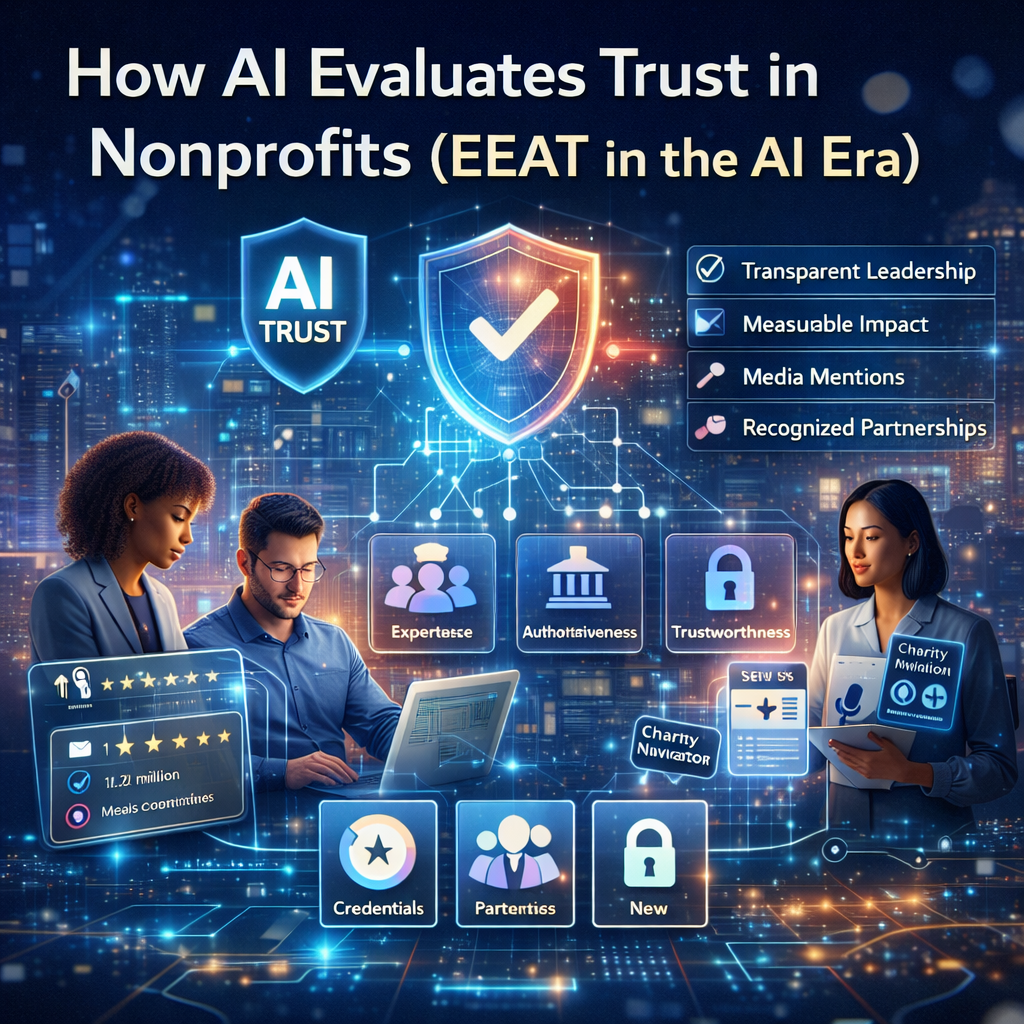
How AI Evaluates Trust in Nonprofits (EEAT in the AI Era)
Artificial intelligence doesn’t just rank nonprofits.
It evaluates whether they deserve to be recommended.
That distinction matters.
In traditional search, your organization competed for rankings. In AI-driven search, you compete for inclusion in summaries, recommendations, and citations.
The bar is higher.
For nonprofits — where donations, legitimacy, and public trust are central — this shift changes everything.
Why Trust Is Different in the AI Era
AI-generated answers don’t simply list websites.
They synthesize information.
When someone searches:
- “Is this charity legitimate?”
- “Best nonprofits supporting food insecurity”
- “Where should I donate for disaster relief?”
AI systems evaluate which organizations demonstrate sufficient trust signals to be surfaced confidently.
This isn’t about keyword density.
It’s about credibility clarity.
If your nonprofit lacks structured, transparent authority signals, AI may exclude you entirely — even if you previously ranked well.
Understanding EEAT in Context
Google’s EEAT framework (Experience, Expertise, Authoritativeness, Trustworthiness) has existed for years.
But AI systems operationalize it differently.
Instead of evaluating a single page in isolation, AI systems:
- Cross-reference your organization across the web
- Compare your messaging for consistency
- Evaluate transparency signals
- Analyze authorship clarity
- Look for documented impact evidence
Nonprofits operate in a higher-trust category by default.
Which means ambiguity is costly.
The 6 Trust Signals AI Looks for in Nonprofits
1️⃣ Clear Organizational Identity
AI needs to clearly understand:
- Who you are
- What you do
- Where you operate
- Who you serve
Vague mission statements dilute entity clarity.
Your homepage should define your nonprofit in two precise sentences.
(For structured clarity improvements, see our [AI Optimization Services Page Placeholder].)
2️⃣ Transparent Leadership & Governance
Anonymous content erodes authority.
Strong trust signals include:
- Executive director bio
- Board member listings
- Credential highlights
- Clear contact information
Transparency reduces ambiguity.
Ambiguity reduces recommendation probability.
3️⃣ Documented, Quantified Impact
Statements like “We change lives” are invisible to AI.
Specific statements like:
“We distributed 1.2 million meals to 4,300 families across three counties in 2025.”
Are extractable.
AI favors structured, measurable outcomes.
4️⃣ Third-Party Validation
AI models cross-reference data.
Trust is reinforced when your nonprofit demonstrates:
- Recognized partnerships
- Media mentions
- Charity Navigator ratings
- Government or foundation grants
- Accreditation listings
Consistency across platforms strengthens authority.
5️⃣ Content Expertise
If you publish blog content:
- Are authors identified?
- Do authors demonstrate subject expertise?
- Are claims supported?
- Is medical/legal/financial content appropriately cautious?
Nonprofits in health, legal, or financial assistance categories are evaluated under even stricter scrutiny.
6️⃣ Consistency Across Channels
AI systems compare:
- Your website
- Your Google Business Profile
- Your grant campaigns
- External mentions
- Social profiles
If your mission description differs everywhere, trust scores weaken.
Consistency compounds credibility.
Where Nonprofits Accidentally Erode Trust
Even well-meaning organizations undermine their authority through:
- Outdated leadership pages
- Broken donation forms
- Missing privacy policies
- Anonymous blog posts
- No structured data
- Inconsistent service area messaging
- Poor grant landing page clarity
AI interprets friction as uncertainty.
And uncertainty reduces recommendation likelihood.
How to Strengthen AI-Readable Trust Signals
Here’s where optimization becomes strategic.
Add Author Schema to Articles
Reinforce real expertise.
Clarify Impact Pages
Structure outcomes with measurable data.
Standardize Mission Language
Use consistent phrasing across:
- Homepage
- About page
- Google Business Profile
- Grant campaigns
Implement Structured Data
At minimum:
- Organization schema
- Article schema
- FAQ schema (when appropriate)
Align AIO with Google Ad Grants
Trust influences:
- Quality Score
- Conversion rate
- Account stability
- Policy compliance
AIO isn’t separate from grants.
It supports them.
(See our [Google Grant Management Page Placeholder] to learn how grant strategy and AI optimization work together.)
Why This Matters for 2026 and Beyond
AI-driven summaries are shaping:
- Donation research
- Volunteer decisions
- Grant applications
- Organizational comparisons
- Legitimacy validation
Nonprofits that proactively strengthen trust signals will:
- Appear in AI summaries
- Be cited in conversational search
- Earn stronger donor confidence
- Improve campaign performance
Those that delay risk becoming invisible.
And invisibility compounds over time.
Final Thought
AI visibility is not about gaming algorithms.
It’s about proving credibility at scale.
Nonprofits already have what AI values most:
- Purpose
- Expertise
- Community impact
The opportunity is not reinvention.
It’s structured trust.
Frequently Asked Questions
What is EEAT and why does it matter for nonprofits?
EEAT stands for Experience, Expertise, Authoritativeness, and Trustworthiness. AI systems use these signals to determine whether a nonprofit should be recommended in search results.
Does AI prioritize larger nonprofits?
Not necessarily. AI prioritizes clarity, consistency, and documented credibility — not organizational size.
How does trust impact Google Ad Grant performance?
Stronger trust signals often improve Quality Score, conversion rates, and compliance stability within Google Ad Grant accounts.